IDY Co . , Ltd . | 10 November 2026
Abstract The National Police Agency's ransomware surveys identify internet-exposed VPN appliances as the most frequently reported infection route among valid responses in both 2025 and the first half of 2026 [ 1 ] [ 2 ] . Disclosures of data leaks in Japan have increased sharply since September 2026 , and public bodies have pointed to the possible use of AI in target research and compromise [ 4 ] [ 5 ] [ 8 ] . This report examines how internet-facing listening endpoints become starting points for discovery and compromise , and proposes a private cellular architecture that replaces VPN access with a carrier's private 5G network to separate inter-site traffic from the internet . The architecture addresses three requirements — hidden , inaccessible and resilient — without wired access-line construction and with redundancy using private-network SIMs from multiple carriers .
1 . Introduction Internet VPNs have been widely used for inter-site communications and maintenance access . Because VPN appliances listen for connections on the internet , their presence makes them targets for discovery . As attacks become increasingly automated , reducing these internet-visible entry points is an important challenge .
Section 2 reviews statistics and public advisories . Section 3 examines attack sequences , contributing factors and countermeasure requirements . Section 4 presents the proposed architecture , Section 5 discusses redundancy , Section 6 examines deployment , and Section 7 defines the scope and limitations .
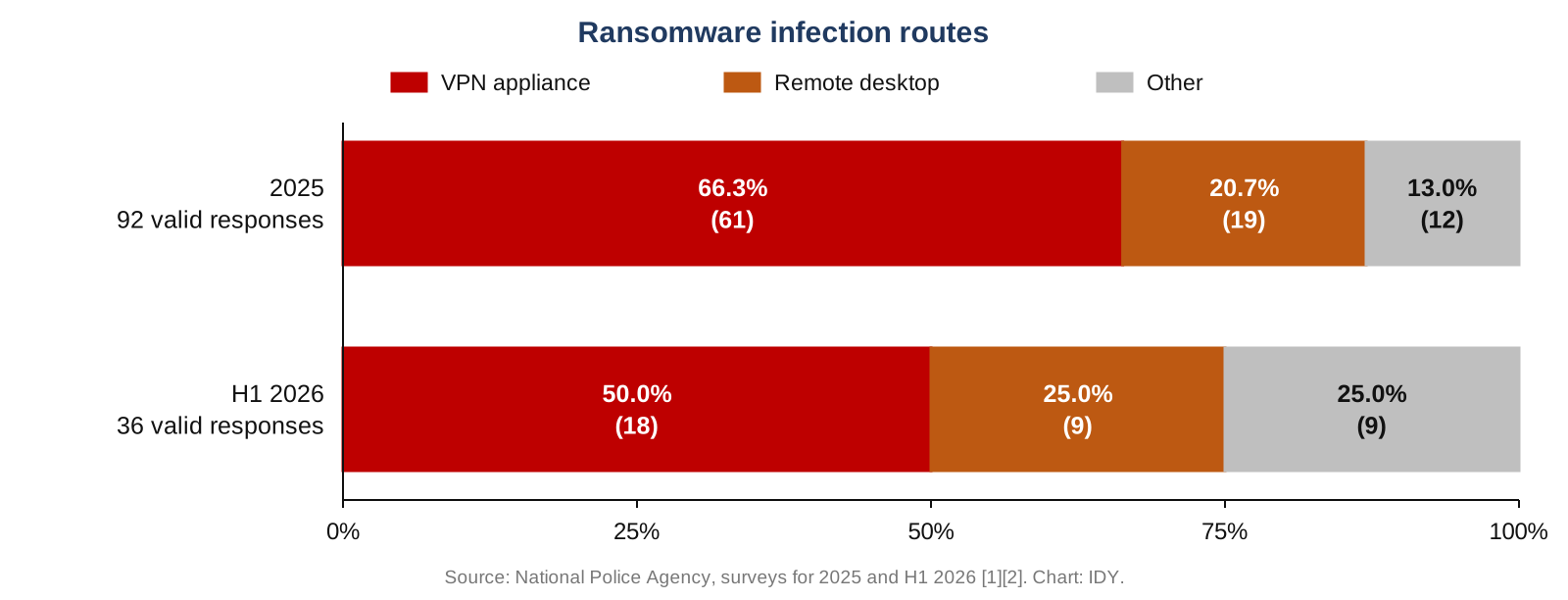
2.1 Ransomware infection routes According to the National Police Agency , 123 ransomware incidents were reported to police in the first half of 2026 , the highest half-year total [ 1 ] . Of 36 valid responses on infection routes , 18 ( 50.0 % ) cited VPN appliances and nine ( 25.0 % ) cited remote desktop access . In 2025 , VPN appliances accounted for 61 of 92 valid responses ( 66.3 % ) [ 2 ] , making them the most frequently reported route in both periods ( Figure 1 ) .
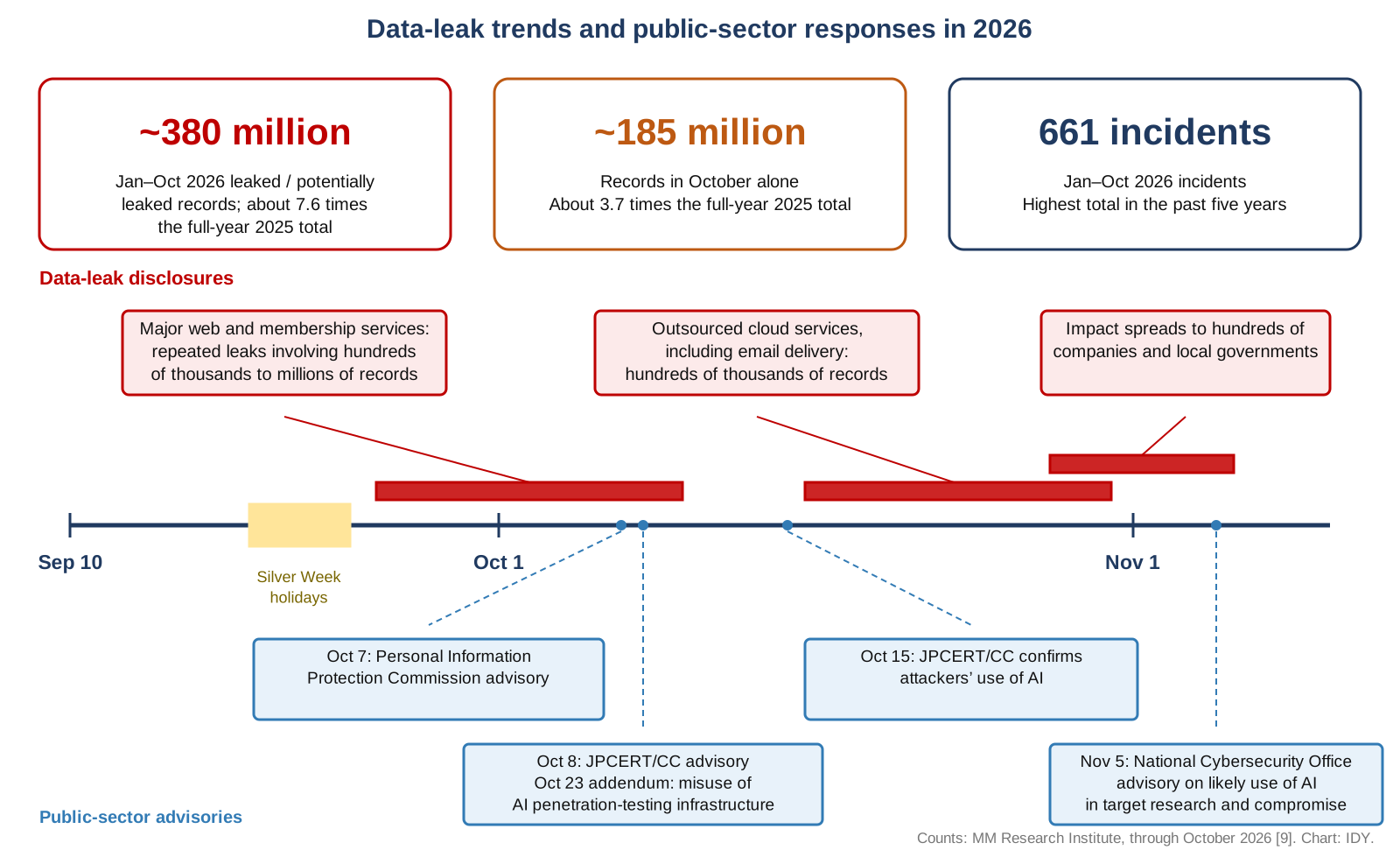
Figure 1 . Ransomware infection routes , based on references [ 1 ] [ 2 ] 2.2 Automated attacks using AI and increasing data leaks Disclosures of data leaks in Japan have increased sharply since September 2026 . According to MM Research Institute , cyberattacks disclosed through the end of October 2026 involved approximately 376 million leaked or potentially leaked records , about 7.6 times the 49.53 million records in all of 2025 . October alone accounted for approximately 185 million records . The January – October totals of 661 incidents and 45 major incidents involving at least one million records were both the highest in the past five years [ 9 ] ( Figure 2 ) .
Figure 2 . Data-leak trends in 2026 and responses by public bodies ; counts based on reference [ 9 ] The Personal Information Protection Commission [ 3 ] , JPCERT / CC [ 4 ] , the National Cybersecurity Office [ 6 ] and the Ministry of Internal Affairs and Communications [ 7 ] subsequently issued advisories . In its investigation of infrastructure potentially used in attacks , JPCERT / CC confirmed that attackers had used AI for activities including scanning for known vulnerabilities [ 5 ] . The National Cybersecurity Office also stated that attackers were highly likely to be using AI for target research and compromise [ 8 ] . AI can enable discovery of internet-reachable devices at a scale and speed difficult to achieve manually .
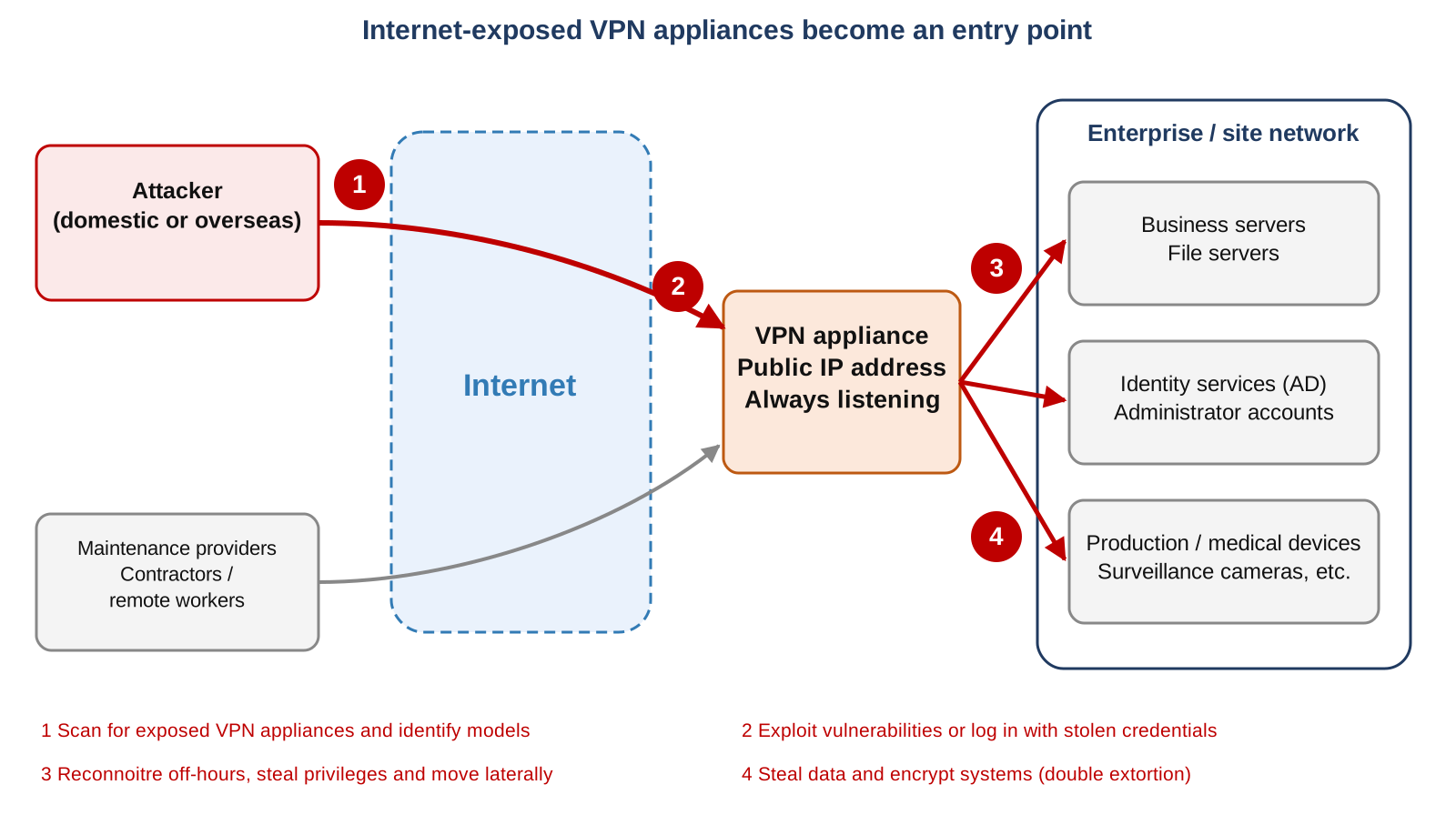
3 . Problems and contributing factors 3.1 A typical attack sequence Attacks through VPN appliances generally follow the sequence in Figure 3 . Attackers scan for public VPN appliances and identify their models , then exploit vulnerabilities or use stolen credentials to sign in as legitimate users . They subsequently conduct internal reconnaissance and lateral movement , ultimately stealing data and encrypting systems with ransomware .
Figure 3 . A typical attack sequence through a VPN appliance These incidents have encouraged replacement of internet-exposed VPN appliances with other connectivity methods .
3.2 Main factors enabling attacks The attacks described above are enabled by three main factors .
( 1 ) Exposed entry points VPN appliances listen for internet connections and can therefore be discovered by scanning . When vulnerabilities become public , devices awaiting remediation can become targets within a short period .
( 2 ) Dependence on credentials Where access depends on credentials such as IDs and passwords , leaked credentials can allow an attacker to enter as a legitimate user .
( 3 ) Increasing entry points More sites and contractors mean more VPN endpoints and managed devices , making consistent updates and monitoring more difficult .
3.3 Countermeasure requirements Based on these factors , this report defines three requirements .
( a ) Hidden : No internet-facing listening endpoint should be present for internet-based discovery .
( b ) Inaccessible : Only devices with SIMs registered with the carrier should be able to access the network ; credentials alone should not establish connectivity .
( c ) Resilient : Redundancy should address carrier outages and congestion so that moving to a private network does not compromise business continuity .
4.1 W ired and cellular private networks Wired private networks , including IP-VPN and leased lines , also separate communications from the internet . However , connecting numerous distributed sites requires access-line construction , cost and lead time at each site . Cellular private networks using SIMs provisioned for a carrier's private service can be activated without access-line construction ( Table 1 ) .
Table 1 . Wired and cellular private networks Aspect Wired private network Private cellular network Deployment cost Construction and monthly service fees per site No access-line construction ; equipment and SIM / private-service fees apply Lead time Weeks to months Potentially a few hours once the service and SIMs are ready ( * 1 ) Location Fixed sites where a wired service can be installed Temporary sites , outdoor equipment and vehicles Redundancy Additional line installation and contract Multiple SIMs across carriers Relocation and expansion Further construction required Move the gateway and SIMs
Table 1 . Wired and cellular private networks
Deployment cost
Wired private network Construction and monthly service fees per site
Private cellular network No access-line construction ; equipment and SIM / private-service fees apply Lead time
Wired private network Weeks to months
Private cellular network Potentially a few hours once the service and SIMs are ready ( * 1 ) Location
Wired private network Fixed sites where a wired service can be installed
Private cellular network Temporary sites , outdoor equipment and vehicles Redundancy
Wired private network Additional line installation and contract
Private cellular network Multiple SIMs across carriers Relocation and expansion
Wired private network Further construction required
Private cellular network Move the gateway and SIMs * 1 Installation and configuration time assumes that the private-network service contract and SIMs are already in place .
Wired private networks remain a strong option for large fixed sites with continuous high-volume traffic . A combination of wired and cellular networks may be appropriate to the scale and purpose of each site .
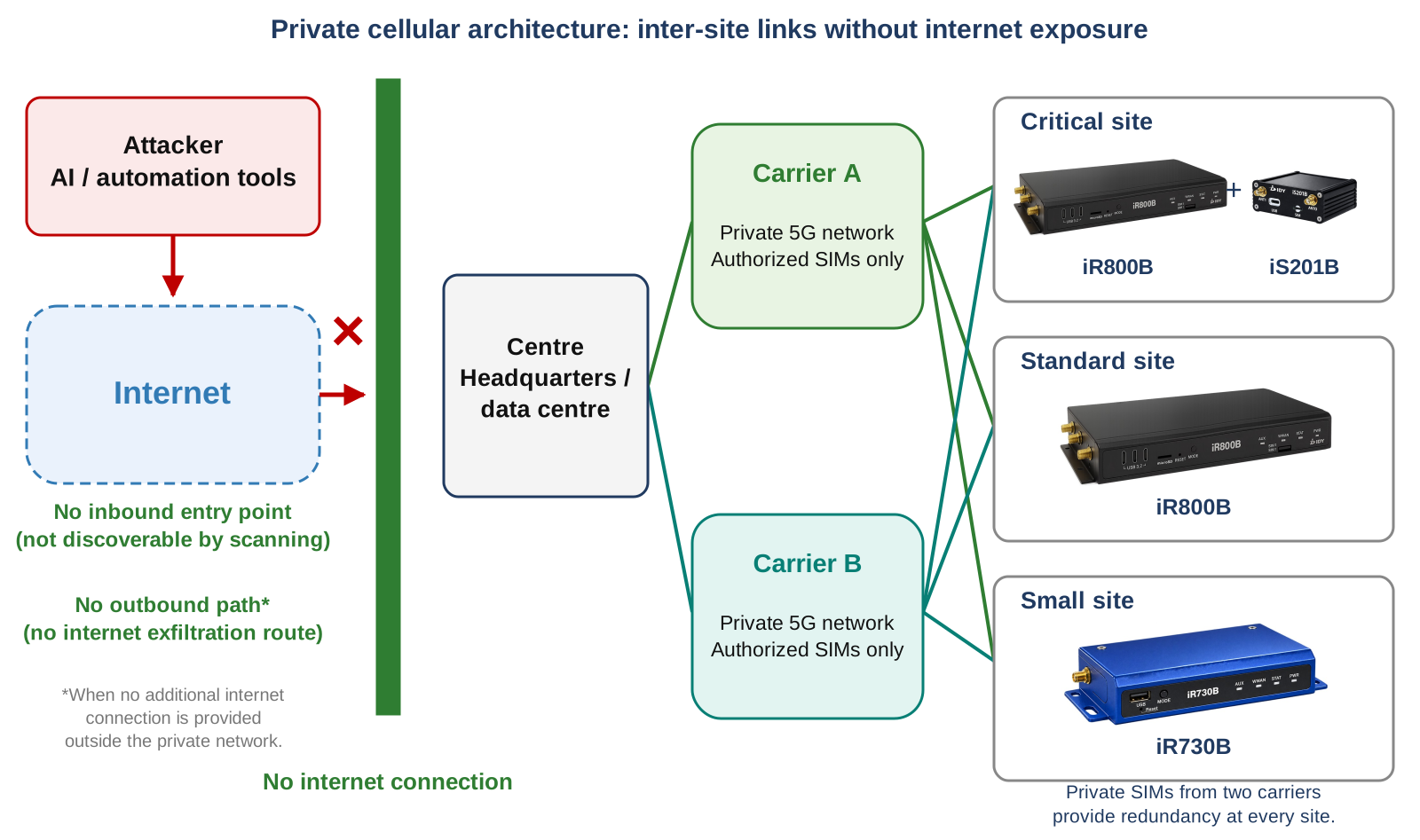
4.2 IDY's recommended private cellular architecture The proposed architecture connects sites to a central location , such as headquarters or a data center , through IDY 5G edge gateways including iR800B and iR730B and a carrier's private 5G network . No internet breakout is provided ; inter-site communications remain within the private network ( Figure 4 ) .
Figure 4 . IDY's recommended private cellular architecture The architecture addresses the requirements in Section 3.3 as follows .
( a ) Hidden : There is no VPN appliance listening through a public IP address , so internet scanning cannot discover that entry point .
( b ) Inaccessible : Only devices with carrier-registered SIMs can access the private network . Contractor access can also be restricted or suspended per SIM .
( c ) Resilient : Every site uses private-network SIMs from two carriers for cross-carrier redundancy ( Section 5 ) .
Where no other internet connection is provided , even a compromised device at a site has no route to communicate with an external command server or exfiltrate data over the internet . Table 2 compares the architecture with internet VPN access .
Table 2 . Internet VPN and private cellular architectures Aspect Internet VPN Private cellular architecture AI scanning Public-IP listeners can be discovered No internet-facing listener Access requirements ID / password , certificates and other controls ; stolen credentials can enable access Registered SIM and private-network authentication ; devices without an authorized SIM cannot connect Vulnerability exposure Internet-facing VPN vulnerabilities can be directly targeted External reachability required for exploitation is reduced Internet route May provide a route for external communication and data theft No private-network internet breakout when no other internet connection is provided
Table 2 . Internet VPN and private cellular architectures
AI scanning
Internet VPN Public-IP listeners can be discovered
Private cellular architecture No internet-facing listener Access requirements
Internet VPN ID / password , certificates and other controls ; stolen credentials can enable access
Private cellular architecture Registered SIM and private-network authentication ; devices without an authorized SIM cannot connect Vulnerability exposure
Internet VPN Internet-facing VPN vulnerabilities can be directly targeted
Private cellular architecture External reachability required for exploitation is reduced Internet route
Internet VPN May provide a route for external communication and data theft
Private cellular architecture No private-network internet breakout when no other internet connection is provided 4.3 Architecture requirements and iR800B suitability To maintain operations after replacing VPN access with private cellular connectivity , site equipment must provide appropriate 5G performance , wired interfaces suitable for the site's core network , and redundancy . Table 3 relates these requirements to iR800B capabilities .
Table 3 . Architecture requirements and iR800B suitability Requirement iR800B specification Suitability 5G SA / NSA , Sub-6 ; iR800B-101 / iR800B-102 Release 16 ; iR800B-107 Release 17 ; measured DL 1.94Gbps ( * 2 ) Helps maintain inter-site throughput after replacing VPN access Redundancy 2 nanoSIMs ; 3 SIM / 2 Active with iS201B Cross-carrier redundancy and two active paths in the highest configuration Automatic recovery Reconnect → soft reset → hardware reset → device restart Autonomous recovery at unattended sites Wired interfaces 10GbE SFP+ ×1 ; 10GbE RJ-45 ×1 ; 1GbE RJ-45 ×2 Interfaces for site core networks Environmental tests JIS E 4031:2013 category 1A ; JIS D 1601:1995 Supports varied industrial , outdoor and vehicle environments Development and manufacturing Japanese manufacturer Customization and long-term maintenance
Table 3 . Architecture requirements and iR800B suitability
5G
iR800B specification SA / NSA , Sub-6 ; iR800B-101 / iR800B-102 Release 16 ; iR800B-107 Release 17 ; measured DL 1.94Gbps ( * 2 )
Suitability Helps maintain inter-site throughput after replacing VPN access Redundancy
iR800B specification 2 nanoSIMs ; 3 SIM / 2 Active with iS201B
Suitability Cross-carrier redundancy and two active paths in the highest configuration Automatic recovery
iR800B specification Reconnect → soft reset → hardware reset → device restart
Suitability Autonomous recovery at unattended sites Wired interfaces
iR800B specification 10GbE SFP+ ×1 ; 10GbE RJ-45 ×1 ; 1GbE RJ-45 ×2
Suitability Interfaces for site core networks Environmental tests
iR800B specification JIS E 4031:2013 category 1A ; JIS D 1601:1995
Suitability Supports varied industrial , outdoor and vehicle environments Development and manufacturing
iR800B specification Japanese manufacturer
Suitability Customization and long-term maintenance * 2 IDY measurements using iR800B-102 [ 10 ] and Anritsu MT8000A ( 5G SA n79 , 2CC CA , 200MHz total bandwidth , 4 × 4 MIMO ) . iperf3 ran on a LAN-side PC connected over 10GbE using the standard internal USB connection . The PCIe configuration achieved 2.34Gbps , and iperf3 running inside the device achieved 2.45Gbps .
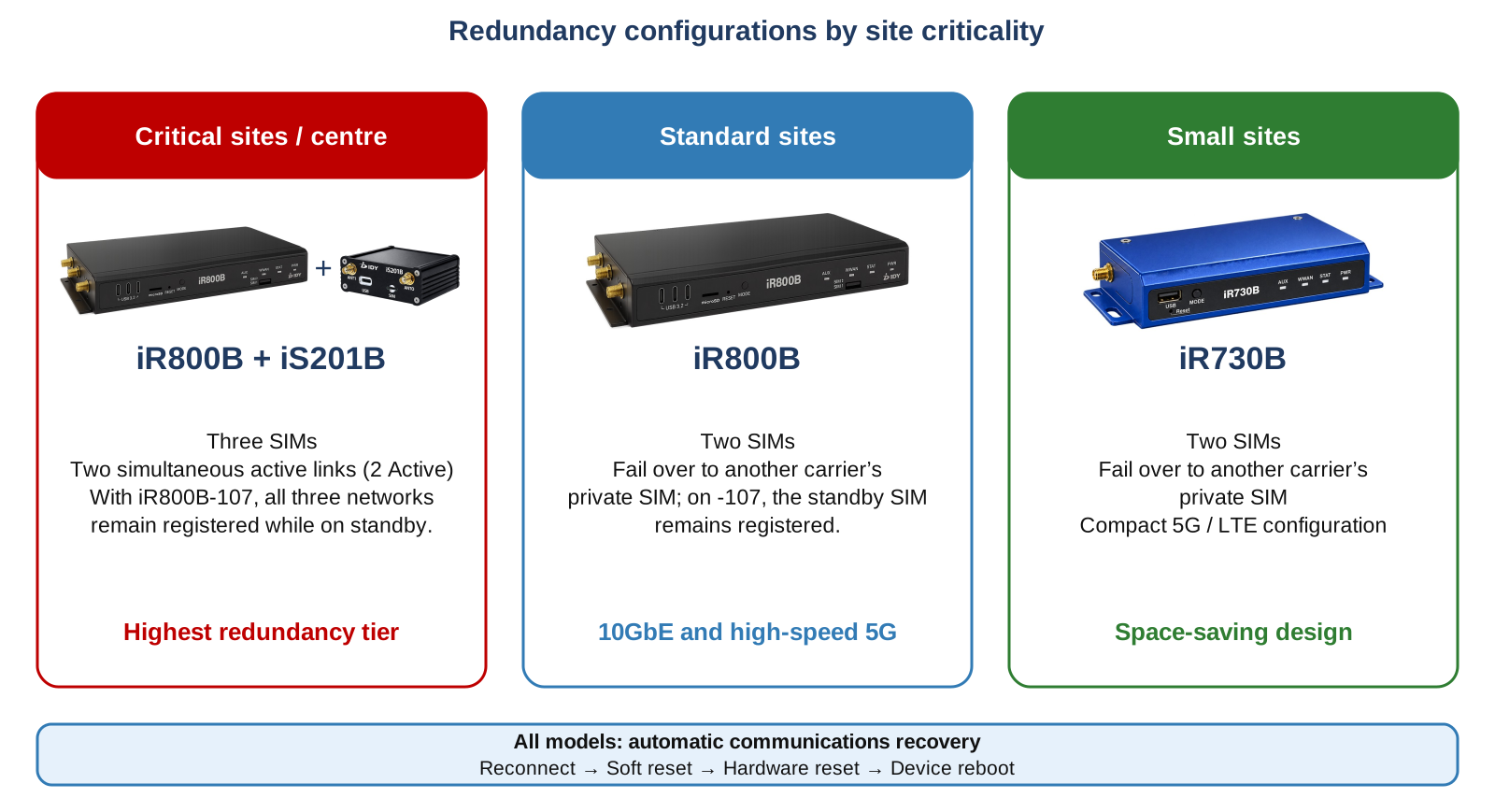
5 . Redundancy Carrier outages and congestion are key concerns when adopting cellular private networks . IDY offers three levels of redundancy according to site criticality ( Figure 5 ) [ 11 ] .
Figure 5 . Redundancy configurations according to site criticality The highest configuration connects a 5G USB modem , iS201B , to iR800B over USB 3.2 . Three SIMs support two communications paths simultaneously ( 2 Active ) . With iR800B-107 , all three lines remain registered with base stations : two Active and one Standby . Keeping the standby line registered reduces the processing required before switching compared with configurations requiring registration . iR800B-102 also supports two simultaneous paths with iS201B , but switching to its internal standby SIM requires base-station registration and therefore takes longer .
The relevant criteria are the number of registered lines , simultaneous communications paths and available failover routes , rather than SIM count alone . IDY designs link monitoring , fault detection , route selection , post-switch connectivity checks and recovery assessment as a coordinated communications-control process . All models also attempt staged recovery after a communications interruption : reconnection , radio soft reset , hardware reset and device restart .
* 3 Switching time depends on registration state , carrier , detection criteria and routing configuration . Bandwidth aggregation and uninterrupted switching require application-specific system design and control .
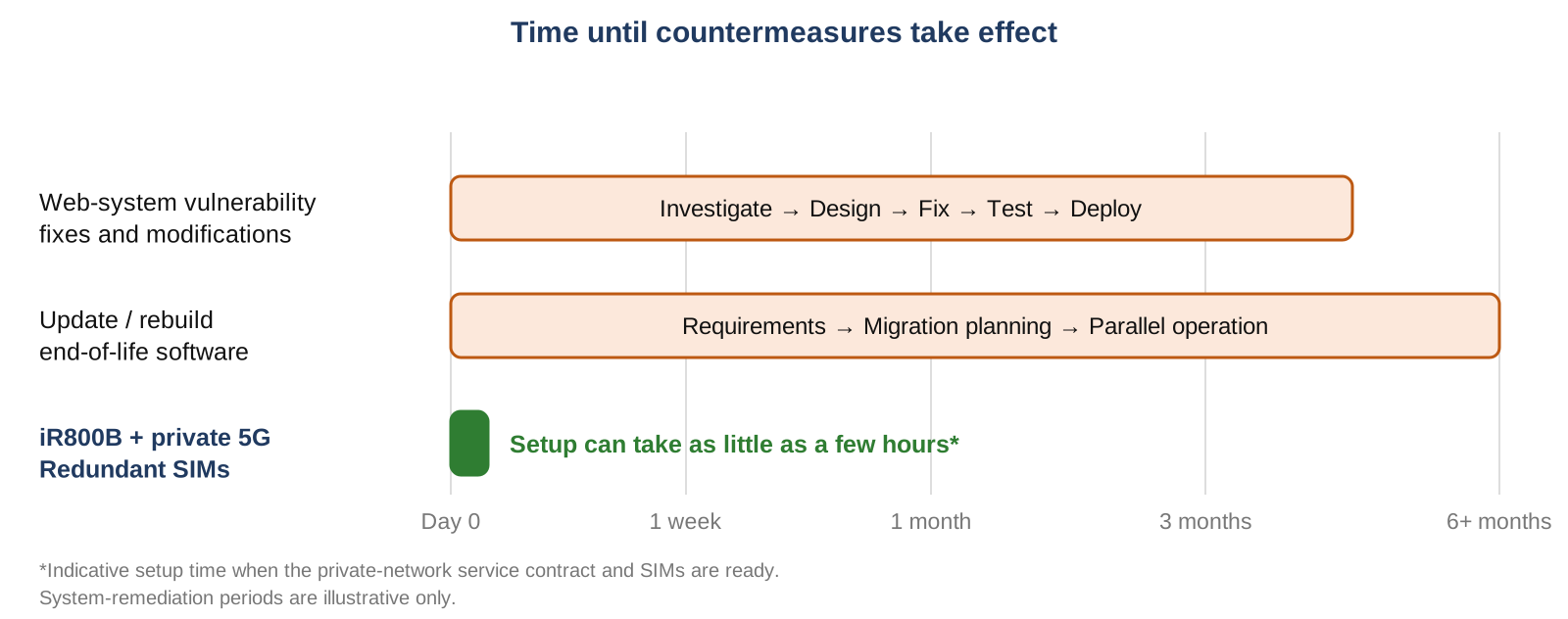
6 . Deployment Vulnerability remediation and system redevelopment commonly take months , while scanning continues . Private cellular connectivity can be introduced without modifying existing applications . When the private-network service contract and SIMs are ready , equipment installation and configuration may be completed in a few hours ( * 1 , Figure 6 ) . The architecture can therefore also reduce exposed entry points while fundamental remediation is being completed .
Figure 6 . Time until countermeasures take effect ( general illustration ) 7 . Scope and limitations This architecture addresses non-public communications , such as inter-site and maintenance access previously carried over an internet VPN . Public websites and services require internet reachability and are outside its scope . They require complementary measures such as WAF , vulnerability assessment and prompt patching .
Even within a private network , compromised authorized devices can enable intrusion . Internal device management and updates remain necessary . If a site or central location has other internet connections , those routes also require management and monitoring .
8 . Conclusion This report examined how internet-facing VPN appliances become starting points for discovery and compromise , and proposed moving inter-site communications to a private 5G network . The architecture addresses three requirements : removing listening endpoints ( hidden ) , SIM-based connection control ( inaccessible ) and redundancy across carriers ( resilient ) . It can be deployed without wired access-line construction . Selecting among iR800B with iS201B , standalone iR800B and iR730B according to site criticality supports both security and business continuity .
Company and product names are trademarks or registered trademarks of their respective owners .
Appendix . Product specifications A . 1 iR800B 5G edge gateway An industrial 5G edge gateway supporting 10GbE that serves as the site-side core of the proposed architecture .
Table A . 1 . Main iR800B specifications [ 12 ] Item Specification 3GPP iR800B-101 / - 102 ( Rel . 16 ) iR800B-107 ( Rel . 17 ) 5G NR CA iR800B-101 : 2CC CA / 120MHz iR800B-102 : 3CC CA / 200MHz LTE Bands B1 / B3 / B8 / B18 / B19 / B26 / B28 / B39 / B40 / B41 / B42 5G NR Bands n1 / n3 / n28 / n40 / n41 / n77 / n78 / n79 MIMO DL 4 × 4 MIMO / UL 2 × 2 MIMO 5G Mode SA / NSA / Sub-6 SIM nanoSIM × 2 10GbE SFP + × 1 / RJ-45 × 1 1GbE RJ-45 × 2 Wireless LAN Wi-Fi 6 ( with WISE CONNECT® Wi-Fi module ) Bluetooth Bluetooth 5.2 Expansion Interface WISE CONNECT® CPU Arm Cortex-A73 Quad-core / 1.8GHz USB USB 3.2 Host × 3 Storage 8 GB eMMC / microSD Industrial I/O RS232 / RS485 / DIO × 2 Positioning GNSS Power Input DC 9 – 24V / USB PD , 65W or higher with 20V output Dimensions / Weight 105 × 200 × 25mm / 650g ( excluding WISE CONNECT® modules and accessories ) Storage / Humidity - 20 – +70°C / 10 – 95 % RH , non-condensing Operating Temperature -10°C to +60°C Railway Vibration JIS E4031:2013 — Rolling stock equipment — Vibration and shock tests / Classification 1A Automotive Vibration JIS D1601:1995 — Vibration testing methods for automobile parts
Table A . 1 . Main iR800B specifications [ 12 ]
3GPP
Specification iR800B-101 / - 102 ( Rel . 16 ) iR800B-107 ( Rel . 17 ) 5G NR CA
Specification iR800B-101 : 2CC CA / 120MHz iR800B-102 : 3CC CA / 200MHz LTE Bands
Specification B1 / B3 / B8 / B18 / B19 / B26 / B28 / B39 / B40 / B41 / B42 5G NR Bands
Specification n1 / n3 / n28 / n40 / n41 / n77 / n78 / n79 MIMO
Specification DL 4 × 4 MIMO / UL 2 × 2 MIMO 5G Mode
Specification SA / NSA / Sub-6 SIM
Specification nanoSIM × 2 10GbE
Specification SFP + × 1 / RJ-45 × 1 1GbE
Specification RJ-45 × 2 Wireless LAN
Specification Wi-Fi 6 ( with WISE CONNECT® Wi-Fi module ) Bluetooth
Specification Bluetooth 5.2 Expansion Interface
Specification WISE CONNECT® CPU
Specification Arm Cortex-A73 Quad-core / 1.8GHz USB
Specification USB 3.2 Host × 3 Storage
Specification 8 GB eMMC / microSD Industrial I/O
Specification RS232 / RS485 / DIO × 2 Positioning
Specification GNSS Power Input
Specification DC 9 – 24V / USB PD , 65W or higher with 20V output Dimensions / Weight
Specification 105 × 200 × 25mm / 650g ( excluding WISE CONNECT® modules and accessories ) Storage / Humidity
Specification - 20 – +70°C / 10 – 95 % RH , non-condensing Operating Temperature
Specification -10°C to +60°C Railway Vibration
Specification JIS E4031:2013 — Rolling stock equipment — Vibration and shock tests / Classification 1A Automotive Vibration
Specification JIS D1601:1995 — Vibration testing methods for automobile parts A . 2 iS201B 5G USB modem A USB-powered 5G modem that adds an independent communications path using a third SIM when connected to iR800B over USB 3.2 .
Table A . 2 . Main iS201B specifications [ 13 ] Item Specification Models iS201B-101 / iS201B-102 3GPP Release 16 / 5G SA and NSA 5G NR Sub-6GHz / n1 , n3 , n28 , n40 , n41 , n77 , n78 , n79 5G NR CA iS201B-101 : 2CC CA / 120MHz iS201B-102 : 2CC / 3CC CA / 200MHz MIMO DL 4x4 MIMO / UL 2x2 MIMO LTE 101 : Cat . 18 , up to 5CA / 102 : Cat . 20 , up to 7CA USB USB 3.2 Type-C / USB bus power SIM 1x nanoSIM Antenna 4x LTE / Sub-6 SMA / 1x GNSS Power USB bus power 7.5W ( 15W or higher recommended ) Dimensions / Weight 60 ( 86 incl . SMA ) x 81 x 32mm / 190g Operating Temperature - 10 to 60°C Storage / Humidity - 20 to 70°C / 10 – 95 % RH , non-condensing
Table A . 2 . Main iS201B specifications [ 13 ]
Models
Specification iS201B-101 / iS201B-102 3GPP
Specification Release 16 / 5G SA and NSA 5G NR
Specification Sub-6GHz / n1 , n3 , n28 , n40 , n41 , n77 , n78 , n79 5G NR CA
Specification iS201B-101 : 2CC CA / 120MHz iS201B-102 : 2CC / 3CC CA / 200MHz MIMO
Specification DL 4x4 MIMO / UL 2x2 MIMO LTE
Specification 101 : Cat . 18 , up to 5CA / 102 : Cat . 20 , up to 7CA USB
Specification USB 3.2 Type-C / USB bus power SIM
Specification 1x nanoSIM Antenna
Specification 4x LTE / Sub-6 SMA / 1x GNSS Power
Specification USB bus power 7.5W ( 15W or higher recommended ) Dimensions / Weight
Specification 60 ( 86 incl . SMA ) x 81 x 32mm / 190g Operating Temperature
Specification - 10 to 60°C Storage / Humidity
Specification - 20 to 70°C / 10 – 95 % RH , non-condensing Measured iS201B downlink throughput was 3 , 060Mbps on Windows and 3 , 030Mbps on Ubuntu . Measurements were made in IDY’s evaluation environment with iS201B connected to a PC running iperf3 ( 2CC CA , 200MHz , 4 × 4 MIMO ) . Actual throughput varies with network , radio conditions , OS and test configuration .
A . 3 iR730B 5G edge gateway An industrial 5G / LTE edge gateway inheriting the compact , rugged design and industrial I/O of the iR700B family . Its fanless , compact enclosure suits distributed small sites .
Table A . 3 . Main iR730B specifications [ 14 ] Item Specification Models iR730B-001 / - 002 / - 101 / - 102 3GPP iR730B-001 / - 002 : Rel . 15 iR730B-101 / - 102 : Rel . 16 Mobile Network UMTS / LTE / 5G Sub-6GHz 5G mmWave Not included in the standard specification GNSS / GPS Optional ( antenna / firmware / consultation ) Ethernet 1GbE LAN × 1 / 1GbE LAN - WAN × 1 Expansion Interface WISE CONNECT® ( depending on model and module specifications ) Antenna SMA connector × 6 USB USB 2.0 × 1 Serial / DIO RS232 / RS485 / DIO1 / DIO2 × 1 Display Power / Status / WWAN / AUX LEDs Buttons MODE switch / RESET switch Power Input DC 5V – 16V / AC adapter : DC 12V output Size 77.9 × 125 × 24.8 mm Weight Approx . 320g incl . WISE CONNECT® module , antenna and AC adapter Power Consumption Approx . 20W max . ( 5G / LTE + LAN ) Operating Temperature -10°C to +60°C Storage Temperature -20°C to +70°C Humidity 10 % ~ 95 % RH ( non-condensing ) Environment JIS D1601:1995 — Vibration testing methods for automobile parts JIS E4031:2013 — Rolling stock equipment — Vibration and shock tests
Table A . 3 . Main iR730B specifications [ 14 ]
Models
Specification iR730B-001 / - 002 / - 101 / - 102 3GPP
Specification iR730B-001 / - 002 : Rel . 15 iR730B-101 / - 102 : Rel . 16 Mobile Network
Specification UMTS / LTE / 5G Sub-6GHz 5G mmWave
Specification Not included in the standard specification GNSS / GPS
Specification Optional ( antenna / firmware / consultation ) Ethernet
Specification 1GbE LAN × 1 / 1GbE LAN - WAN × 1 Expansion Interface
Specification WISE CONNECT® ( depending on model and module specifications ) Antenna
Specification SMA connector × 6 USB
Specification USB 2.0 × 1 Serial / DIO
Specification RS232 / RS485 / DIO1 / DIO2 × 1 Display
Specification Power / Status / WWAN / AUX LEDs Buttons
Specification MODE switch / RESET switch Power Input
Specification DC 5V – 16V / AC adapter : DC 12V output Size
Specification 77.9 × 125 × 24.8 mm Weight
Specification Approx . 320g incl . WISE CONNECT® module , antenna and AC adapter Power Consumption
Specification Approx . 20W max . ( 5G / LTE + LAN ) Operating Temperature
Specification -10°C to +60°C Storage Temperature
Specification -20°C to +70°C Humidity
Specification 10 % ~ 95 % RH ( non-condensing ) Environment
Specification JIS D1601:1995 — Vibration testing methods for automobile parts JIS E4031:2013 — Rolling stock equipment — Vibration and shock tests Contact For architecture planning and migration from existing VPN or inter-site connections , please use the inquiry form on our website .
IDY Co . , Ltd .