ORDER / INVENTORY
Transactions and flow
When a fixed line, carrier or network device fails, critical operations need another path. IDY engineers multi-carrier 5G and LTE as an always-available business-continuity network.

Ordering, payments, production, cloud applications and remote monitoring all assume connectivity. A network incident at one site can cascade into downtime for customers and business partners.
Transactions and flow
Sales and customers
Factories and control
Core applications
Sites and equipment
Voice and support

Keep production lines, monitoring, control and cloud coordination connected when a primary path fails.

Keep POS, self-checkout, inventory and back-office operations on an available path.
Disasters are not the only cause of downtime. Access lines, carriers, local loops, routers, power and premises wiring must be separated into failure domains and diversified accordingly.
This is more than replacing a primary line with a dormant backup. Fixed access and multiple 5G/LTE carriers are observed together so an available path can remain connected to critical operations.
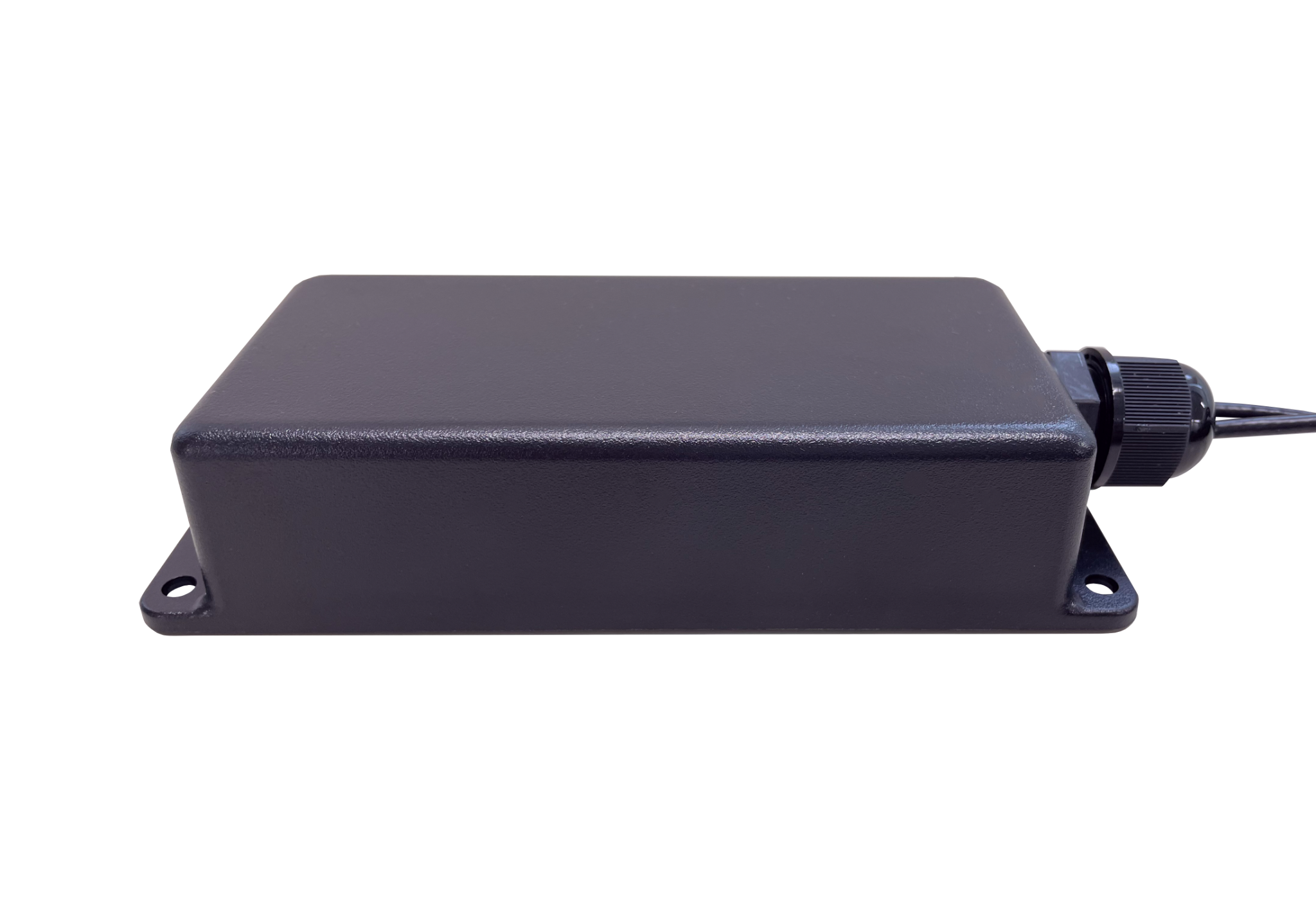
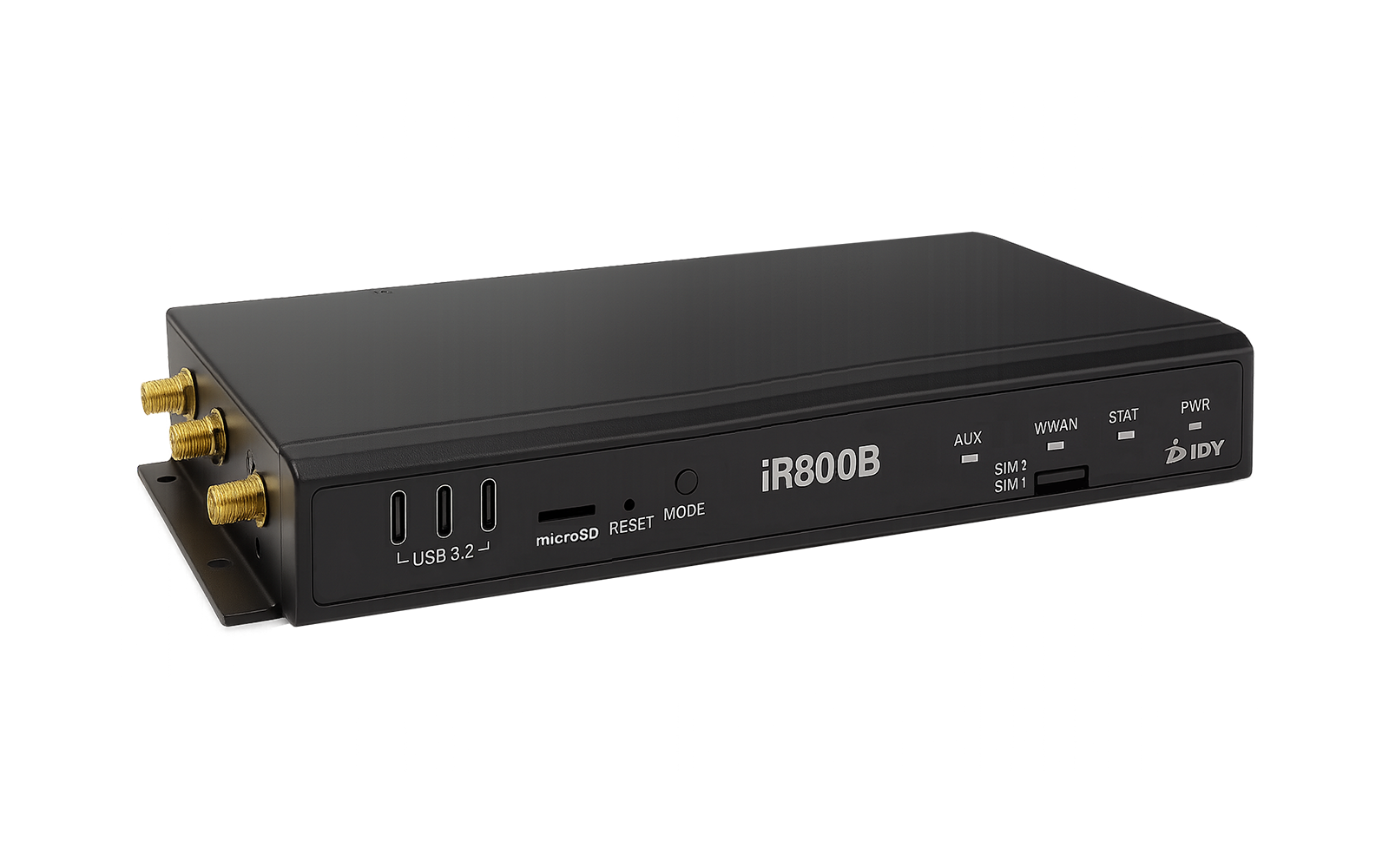
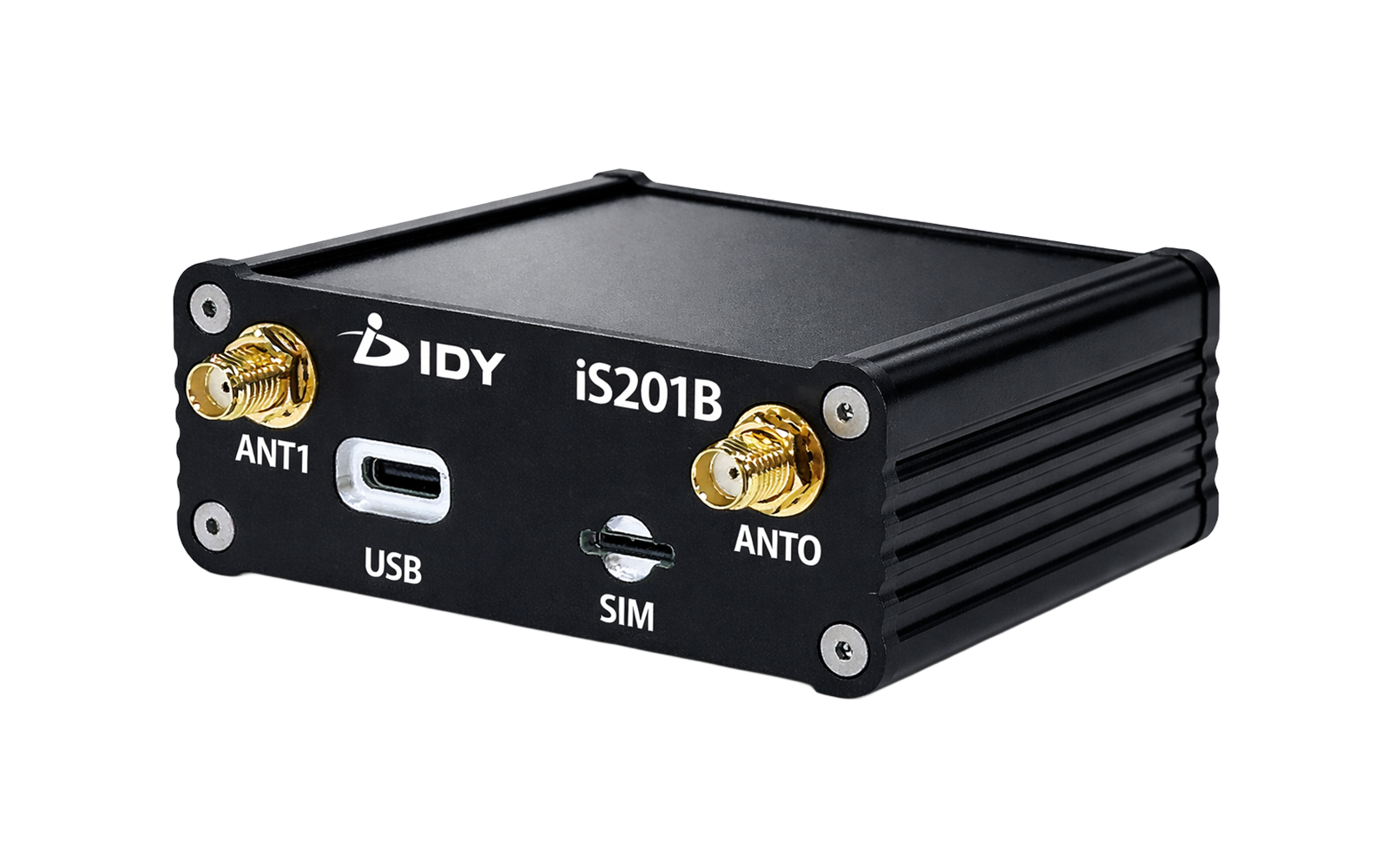
* Path count, concurrent links, carriers, antenna configuration and switching policy are engineered for the workload, site, radio conditions and service contracts.
A backup that is only activated during an incident may not be ready when needed. Connectivity, quality, SIMs and devices are monitored in normal operation, making switching and recovery part of the operating model.
Observe paths and devices
Assess thresholds and impact
Move to an available path
Keep workloads connected
Restore and record history
Choose across Rel.15, Rel.16 and Rel.17 platforms—from highly redundant headquarters and data centers to distributed stores, factories and remote sites—according to availability and installation requirements.
High-redundancy edge for headquarters, data centers and primary factories
View product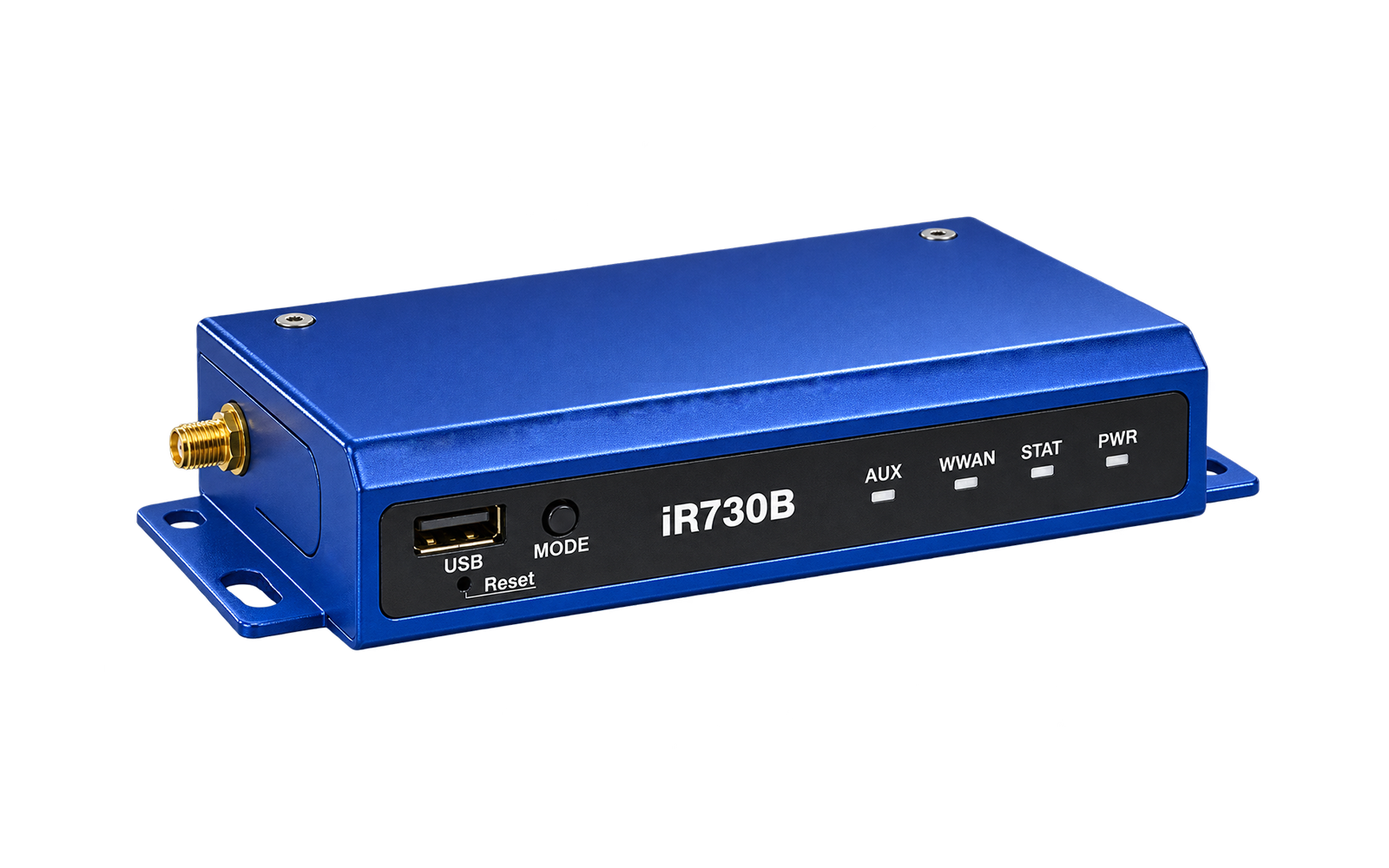
Compact edge for stores, branches and remote monitoring sites
View productAdds an independent 5G path to existing systems or iR800B
View product| COMPARISON | iR800B | iR730B | iS201B |
|---|---|---|---|
| 3GPP | Rel.16 Rel.17: iR800B-107 | Rel.15 / Rel.16 RedCap: iR730B-105 Rel.17: iR730B-107 | Rel.16 |
| REDUNDANCY | -107: Dual standby With iS201B: 3 SIM / 2 Active | -105: RedCap / -107: Dual standby | Adds an independent 5G path |
| KEY INTERFACE | 10GbE SFP+ / RJ-45 USB-C | 1GbE LAN / LAN-WAN USB / RS232 / RS485 / DIO | USB Type-C Windows / Linux |
| BEST FIT | HQ / data center / primary factory | Store / branch / remote site | Existing PC / server / added path |
* 3GPP Release, standby/concurrent-link capability and interfaces vary by product model and communication specification. Dual standby and 2 Active are different configurations. See each product specification for details.
See sites, paths, critical workloads, incidents, switching and recovery in one view. Operators can understand how each site is connected and where business impact remains.
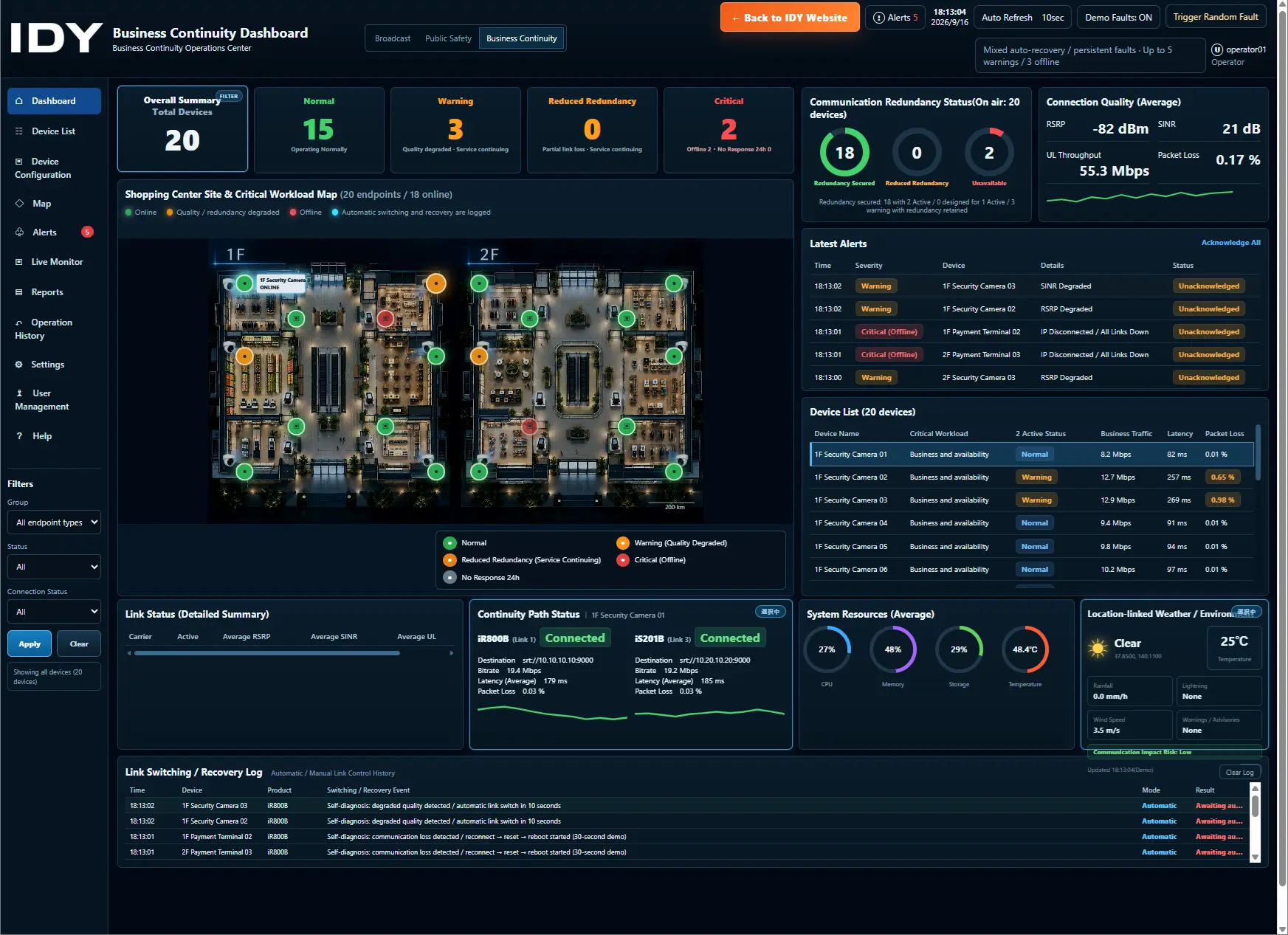
In the interactive demo, select an icon to view the endpoint name, link condition and continuity-path status.
* The page shows a static interface preview. Open the working demo in a new tab. Site names, critical workloads, monitored data, thresholds and permissions are adapted to the actual operation.
BCP does not begin with device selection. Start with critical workloads, tolerated downtime, existing assets, path dependencies and post-switch requirements, then connect the design to validation and operations.
Critical workloads and priority
Networks, power, assets and cloud
Carriers, devices and antennas
Switching, recovery and performance
Monitoring history and exercises
Tell us about current paths, sites, critical workloads, tolerated downtime and incident operations. We can begin with dependencies and the overall architecture before selecting products.